First-year rental taxes
Rental property tax deductions: what you can deduct in your first year
By Rentlab Team. Checked against IRS sources on .
For your 2026 tax return, filed in 2027. The IRS's 2026 publications are not out yet, so each rule was checked against the edition named in its sources.
In your first year as a landlord, you can deduct many everyday rental property expenses, including insurance, repairs, property tax, and mortgage interest.[1] These costs generally count in the year you pay them, once the property is ready and available for rent.[2][3][4] You can also recover the building's cost through depreciation (deducting its cost a little each year), generally over 27.5 years.[5]
The tricky part is that not every dollar you spend is a current deduction. Buying costs usually increase your basis (what the property cost you for tax purposes; see what counts), while some loan costs are recovered over time.[6][7] Your down payment, mortgage principal (the part of each payment that pays down the loan), and money deposited into escrow (an account your lender holds to pay your property tax and insurance later) are not current expenses.[8][9][10]
This guide walks through a sample closing statement, explains what to save, and shows how to organize your first-year deductions in Rentlab. It covers the 2026 tax year, for returns filed in 2027.
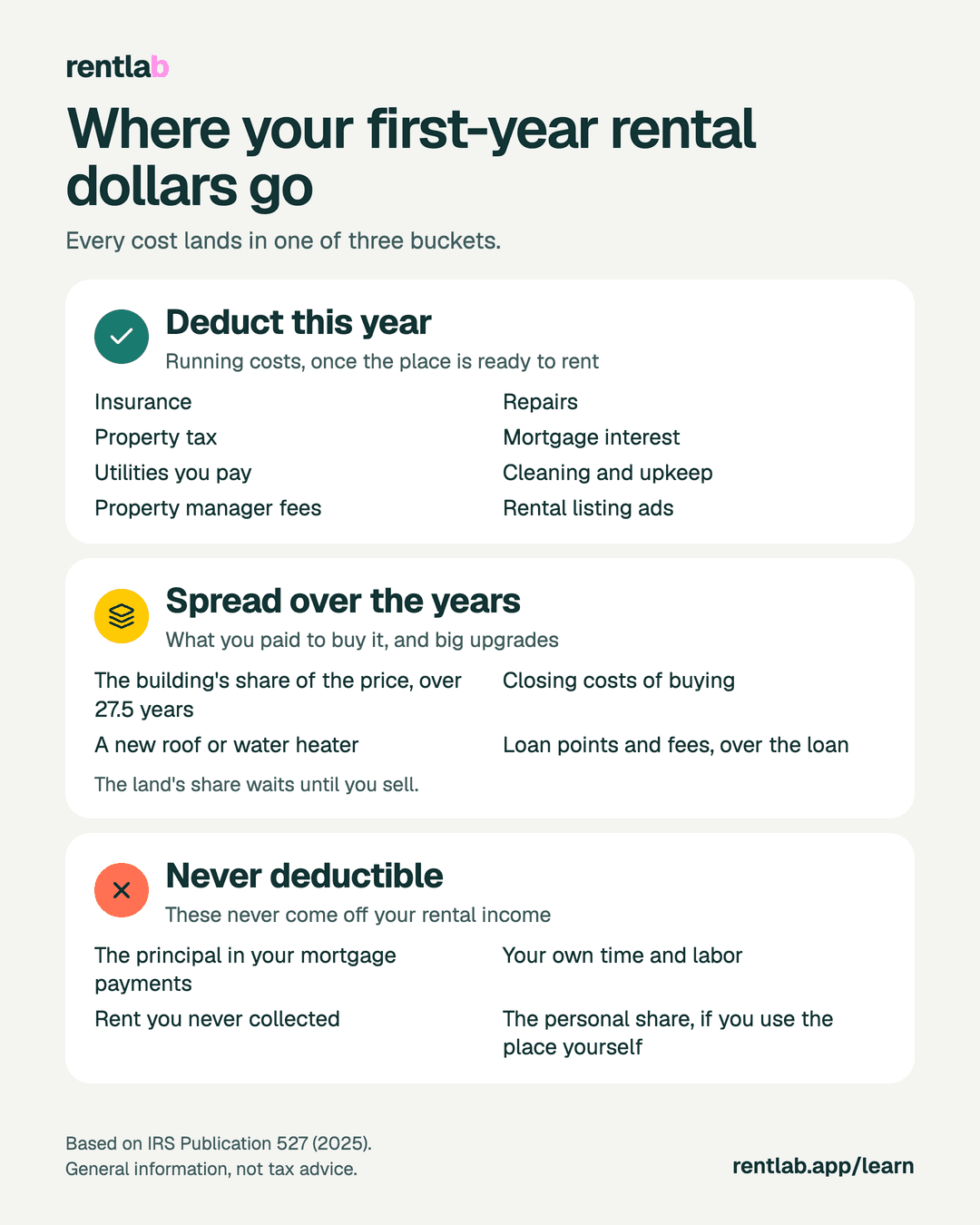

Three buckets for every first-year dollar
Think of your rental property spending as three buckets. Sorting expenses correctly now makes tax time less stressful.
- Deduct this year. These are ordinary and necessary running costs (the IRS's phrase for the normal costs of running a rental), such as insurance, mortgage interest, property tax, repairs, utilities, and management fees.[1] For most individual landlords using the cash method (a method that generally counts expenses in the year you pay them), the expense belongs to the year you pay it.[2] Your property must be ready and available for rent for the usual running-cost deductions to begin.[3][4] Discount points, a fee you pay your lender at closing for a lower interest rate, belong here too, deducted a little each year over the loan's life.[7]
- Add to basis. These are buying costs and improvements that you recover differently from everyday expenses.[6][11] The building's share generally comes back through depreciation over 27.5 years, while the land's share is not depreciated.[5][12]
- Never deductible. Some costs never reduce your rental income on Schedule E (the federal tax form most landlords use to report rental income and expenses).[13] These include mortgage principal, the value of your own labor, and rent a tenant owes but never pays when you use the cash method.[1][9][14]
The same purchase can have different tax treatment depending on what it pays for and when the property becomes available for rent.[4][11] Keep your receipts and closing statement so you can sort each amount correctly.
What exactly is basis?
Basis is what the property cost you, as the IRS counts it. Your preparer depreciates the building's share of it, and it is used to work out your gain when you sell.[5][15] Here is what counts, with the numbers from the example below.
In basis: $302,775
- The full price, $300,000, loan included: your $60,000 down plus the $240,000 loan, which counts even though the bank paid it.[8]
- The buying fees, $2,775: owner's title insurance, the settlement fee, title search, recording, transfer tax and survey, the costs a cash buyer would pay too.[6]
- Two less obvious ones: charges to install utility services, and bills the seller owed that you agreed to pay.[6]
- Later, improvements that last more than a year.[11]
In Rentlab, you record these under the CapEx category.
Not in basis
- Loan costs, $3,585: the points and the lender's fees, deducted over the loan instead.[7][16][17][18] Ask your tax preparer about the lender's fees, because IRS publications differ on them.
- Costs you deduct this year, $4,130.90: your share of the property tax, the interest to your first payment and the insurance premium.[19][20][21]
- The escrow deposit, $1,132.51: it is still your money.[10]
- Rent you paid to live there before closing, if you did.[16]
Your preparer then splits the basis between land and building, and only the building is depreciated.[12][22]
What closing costs are deductible for a rental property?
Your closing statement, the document listing the charges and payments involved in buying your property, is one of your most useful tax records. Some lines represent buying costs that increase your basis.[6] Others are loan costs, prepaid expenses, or money held for future bills.[10][16]
A practical starting point is the cash-buyer test: would you have paid the fee even if you had bought the property with cash? If yes, the cost may belong in your basis. Owner's title insurance, recording fees, transfer taxes, and settlement fees are common examples.[6]
Loan-related charges need a separate review. Discount points are prepaid interest (interest paid up front), which means you generally deduct them over the life of the loan rather than all at once.[7] Other loan costs have less certain treatment, so keep them separate and ask your tax preparer how to recover them.[17]
Here is a quick guide to common closing statement lines.
- Usually add to basis: purchase price, owner's title insurance, settlement fees, title search, deed recording fees, transfer taxes, and survey costs.[6][8]
- Deduct when the conditions are met, mainly that the property is ready and available for rent: eligible property tax, interest paid at closing, and landlord insurance.[4][19][20][21]
- Recover over the loan's life: discount points and, in our example, other loan costs such as the underwriting fee and the lender's title policy.[7][17][18] Ask your tax preparer how to treat those other costs.
- Leave out of current expenses: escrow deposits, which remain your money until the lender pays a bill.[10]
Two less obvious buying costs can also increase basis: charges for installing utility services and amounts the seller owed that you agree to pay.[6] Not every settlement charge belongs in basis, so don't simply add every closing statement line together.[16]
A closing statement, sorted
Imagine buying a single-family house for $300,000 that is ready and listed for rent on closing day, Friday, June 12, 2026, so for tax purposes it is in service from June 12, not from the tenant's move-in date.[3][4] You put $60,000 down and borrow $240,000.
The closing statement's charges total $311,623.41, and here is where that money goes.
- Deduct in 2026$4,130.90, 1.3%
You deduct your share of this year's property tax, which you repaid the seller at closing because they had already paid the whole year (Schedule E line 16), the interest up to your first payment (line 12) and the first year's insurance (line 9), because the house was ready to rent from closing day.[19][20][21]
- Deduct over the loan's life$3,585.00, 1.2%
The points, the $1,200 fee you paid for a lower interest rate, are deducted a little each year over the loan's 30 years.[7] The lender's other fees, such as underwriting, the appraisal and its title policy, are spread over the loan in our example too, but IRS publications differ on them, so ask your tax preparer whether they are spread over the loan or added to basis.[17][18]
- Add to basis$302,775.00, 97.2%
The price and the buying fees, such as owner's title insurance, recording, the transfer tax and the survey, go into basis.[6][8] Your preparer depreciates the building's share over 27.5 years (line 18), about $4,772 for 2026 in this example, and attaches Form 4562 (the IRS form for claiming depreciation) that first year; the land is never depreciated.[5][12][23]
- Not an expense yet$1,132.51, 0.4%
The escrow deposit only holds money for future bills; you deduct each property tax and insurance bill when your lender pays it.[10]
Nothing on this statement belongs in the never-deductible bucket. That bucket fills up later, with items such as mortgage principal and the value of your own labor.[1][9]
Can I deduct rental expenses before renting?
The key date is when the property is ready and available for rent, not when a tenant first pays you. A property can be placed in service while vacant, provided it is ready and available for rent.[3]
From that date, you can deduct ordinary and necessary running costs even if the property is still empty. You cannot deduct rent you expected to collect but did not receive.[4]
Closing day
Ready and listed for rent, the same day
Tenant moves in
Costs from before that date need more care. Improvements made before the property is available for rent that last more than a year go into basis, and fixing a material problem that existed when you bought the property can also count as an improvement.[11][25]
The treatment of other pre-rental costs, such as utilities, routine repairs, cleaning, or insurance while you prepare the property, is less clear in the publications reviewed. The rules for business start-up costs may not clearly establish how those rules apply to a rental property.[24] Keep your receipts and ask your tax preparer before deducting these costs.
Interest and property tax paid before the property is available for rent also raise a separate question. IRS Publication 527 describes circumstances in which carrying charges (costs of owning the property, such as interest and property tax) can be deducted or added to basis, but the specific pre-rental treatment is not clear from the guidance reviewed.[26] Ask your tax preparer how to handle them.
Can I deduct mortgage interest on a rental property?
Generally, yes. Mortgage interest on a rental property goes on Schedule E line 12 when paid to a bank or other financial institution. It reduces your rental income for tax purposes.[27]
Keep your lender's Form 1098, the mortgage interest statement. If you paid $600 or more of interest on the rental mortgage to one lender, you should receive Form 1098 by early February.[28]
Interest paid at closing can count too, for the days the property is available for rent. Check whether your Form 1098 includes it. If it does not, the Schedule E instructions say to report the full deductible amount on line 12 and attach a statement explaining the difference.[21]
Do not confuse interest with principal. The principal portion of your mortgage payment pays down the loan and is never deductible. You recover the building's cost through depreciation instead.[9]
If the property is partly your home, the personal and rental portions have different treatment. Interest for the rental portion goes on Schedule E, while a qualifying personal portion, such as the half of a duplex where you live, may belong on Schedule A, the personal deductions form, if you itemize instead of taking the standard deduction.[27]
Schedule E, Part I: Expenses
This lesson's costs
- Line 5 Advertising:
Rental listing ads[29]
- Line 6 Auto and travel:
Mileage, parking, tolls and overnight rental trips[30][31]
- Line 7 Cleaning and maintenance:
Cleaning and upkeep[29]
- Line 9 Insurance:
Landlord insurance[19]
- Line 10 Legal and other professional fees:
Your preparer's fee for this schedule[32]
- Line 11 Management fees:
Property manager fees[29]
- Line 12 Mortgage interest paid to banks, etc.:
Mortgage interest, the interest paid at closing, and each year's share of points[7][21][27]
- Line 14 Repairs:
Repairs, once it is ready to rent[33]
- Line 16 Taxes:
Property tax[20]
- Line 17 Utilities:
Utilities you pay[29]
- Line 18 Depreciation expense or depletion:
- Line 19 Other:
Small items under the $2,500 safe harbor, if you elect it[34] Ask your preparer about your first year.
Lines this lesson does not cover are left out.
Can I deduct mileage to my rental property?
You can generally deduct local driving for collecting rent or managing, conserving, or maintaining your rental property. Driving between your home and the rental is generally commuting, which is not deductible unless your home qualifies as your principal place of business (your main business location under the applicable tax rules).[35]
For eligible trips in 2026, the standard mileage rate is 72.5 cents per mile from January 1 through June 30, and 76 cents per mile from July 1 onward. You can add parking and tolls. Keep a mileage log, and if you claim car expenses, complete Part V of Form 4562 and attach it.[30]
There is a choice to make when using the standard mileage rate for a car you own. You must use that rate in the first year the car is in service for your rental if you want to use it. If you start by deducting actual car costs instead, you cannot switch to the standard mileage rate later.[36]
Overnight trips can qualify when their main purpose is collecting rent or managing or maintaining the rental. Eligible travel can include 50% of meals. If the trip mixes rental and personal purposes, split the costs. A trip whose main purpose is improving the property is not deducted as travel.[31]
Repairs vs improvements in your first year
A repair keeps your property in good working order, such as fixing a broken lock or painting a room. A repair made after the property is available for rent is generally deducted in the year you pay it, on Schedule E line 14.[33]
An improvement makes the property better, restores it, or adapts it to a new use. Replacing the entire HVAC system is an example. Improvements are generally depreciated rather than deducted all at once.[33]
Does it make the property better, restore it, or adapt it to a new use?
Like replacing the whole HVAC system.
Yes
Improvement
Add it to basis and depreciate it.[33]
- No
Does it fix a material problem that came with the property?
Yes
Improvement too
"Material" is the IRS's word, and it is a judgment call.[25]
- No
Does it keep the property in good working order?
Like fixing a broken lock or painting a room.
Yes
Repair
Deduct it the year you pay it, on line 14, once the property is available for rent.[33]
- No
None of these? Keep the receipt separate and ask your preparer.
Small items
Most items of $2,500 or less can be deducted the year you buy them under the de minimis safe harbor, if you elect it.[34] Ask your preparer about your first year.
A repair to a problem that existed when you bought the property can also count as an improvement if the problem is material, the IRS's word for it.[25] That judgment can be difficult, so keep the receipts separate and ask your preparer if you're unsure.
If you choose the de minimis safe harbor on your tax return (a tax rule that lets you deduct qualifying small purchases right away instead of adding them to basis), you can generally deduct most items costing $2,500 or less per invoice or per item in the year you buy them. The policy must be applied consistently and in place at the start of the tax year. The IRS guidance reviewed does not clearly explain how the start-of-year rule applies in your first rental year.[34] Ask your preparer about using it for 2026, and have the policy in place by January 1, 2027, if you plan to use it for that tax year.
For more detail, read our guide to repairs vs improvements.
What is never deductible
Some costs do not reduce your rental income, even if they feel like part of owning a rental property.
- Mortgage principal: The principal portion of your monthly payment pays down the loan. It is never deductible.[9]
- Your own labor: You cannot deduct the value of your time, even if you handle repairs or management yourself.[1]
- Land depreciation: Land is never depreciated. Its share of basis matters when you sell.[12]
- Uncollected rent: If you use the cash method, rent a tenant owes but has not paid was never counted as income, so you cannot deduct it.[14]
- Most home-to-rental driving: The trip is generally commuting unless your home qualifies as your principal place of business.[35]
- Personal-use costs: If you or your family use the property personally, you must split rental and personal expenses. If personal use exceeds 14 days or 10% of the days rented at a fair rental price, whichever is greater, your rental deductions may be limited.[37]
- Special assessments for local improvements: Charges for new streets, sidewalks, or sewers go into basis. You can't deduct them as a tax and they are never depreciated, but they count when you sell. Assessments for maintenance, repairs, or interest on those improvements can be deductible instead.[38]
These distinctions matter even if your first-year expenses exceed your rental income. Your ability to use a rental loss against other income may be limited, so ask your preparer how those limits apply to you.[39]
Your first-year rental property tax deductions checklist
Gather these records before you prepare your 2026 return. You do not need to memorize every tax rule. You need enough information to classify your costs and support the numbers you report.
- Your closing statement. Mark the costs deductible this year, costs added to basis, loan costs, and escrow deposits.[6] Keep the statement because you will need it to work out depreciation and your gain or loss when you sell.[15]
- The date the property became ready and available for rent. Keep your rental listing and any records showing when the property was ready. This date starts depreciation and your usual running-cost deductions.[3][4]
- The land and building values. Find them on your property tax bill or through the county assessor. If you aren't sure of their fair market values when you bought (what the land and the building were each worth), use the ratio of these values to split your basis between land and building.[12][22]
- Form 1098 from your lender. You should receive it by early February if you paid $600 or more in mortgage interest to one lender.[28] Check Schedule E line 12, and remember that points come from your closing statement, not Form 1098.[7]
- Property tax bills and your lender's escrow statement. Use them to track eligible property tax on Schedule E line 16.[20] An escrow deposit is not itself a deduction. Record the tax bill when your lender pays it from escrow.[10]
- Your insurance declarations page and proof of payment. Check the premium and the period it covers. Eligible insurance generally goes on Schedule E line 9, subject to the rules for prepaid premiums.[19]
- Separate receipts for repairs and improvements. Track repairs on Schedule E line 14 when eligible, and keep improvement costs in basis for depreciation.[11][33]
- A mileage log. Record eligible trips and the distance driven.[35] If claiming car expenses, check Schedule E line 6 and Part V of Form 4562.[30]
- Receipts for work done before the property was available for rent. Improvements that last more than a year, and qualifying fixes for problems that came with the property, go into basis.[11][25] Ask your preparer about other pre-rental expenses.[24]
- Your small-purchase expense policy, if you plan to use the $2,500 safe harbor. Ask your preparer whether you can use the safe harbor for 2026. For 2027, have your policy in place by January 1.[34]
- Your rental tax preparation bill. The portion paid for preparing your rental Schedule E, Part I, is deductible on Schedule E line 10 in the year you pay it.[32]
Keep your closing statement and improvement receipts through the end of the period of limitations (the time the IRS has to review that year's return) for the year you sell the property. Those records help establish depreciation and calculate your gain or loss.[15]
Your next step: enter your closing statement in Rentlab
Sorting your closing statement once, during the week you close, gives your first Schedule E a cleaner starting point. Rentlab files costs that go into basis under a category called CapEx (short for capital expenditures). Its Schedule E report keeps them out of this year's deductions, because the building's share comes back a little each year as depreciation instead. The free plan covers up to 2 units.
- Add your property. Enter the purchase date and price. On a computer, find these under Purchase & investment details. On a phone, use Purchase Info.
- Enter the property tax and insurance lines deductible this year, if the property was ready to rent from closing day. Record them as expenses dated on your closing day. Put the property tax you reimbursed the seller under Taxes, and the insurance premium under Insurance. If the property needed work first, ask your tax preparer about these costs before entering them as current deductions.
- Record the closing costs that go into basis. Add them together as one expense under CapEx, dated on the closing day. Rentlab's Schedule E report keeps CapEx out of current-year deductions. Its Schedule E PDF shows the total on the depreciation line for your tax preparer.
- Leave out interest, loan costs, and escrow deposits. At tax time, enter mortgage interest from your lender's Form 1098 on line 12. Add the interest paid at closing if Form 1098 leaves it out. Your preparer can use your closing statement to handle the loan costs. If the property needed work before it was ready, ask about interest from that period too. Add each property tax and insurance bill when your lender pays it from escrow.
- Keep recording expenses as you pay them. Rentlab adds up the Schedule E lines you record. At tax time, add mortgage interest, including any eligible closing interest missing from Form 1098, and have your preparer calculate depreciation.
The goal is to keep ordinary expenses, buying costs, and loan charges from getting mixed together. You can then give your tax preparer a clearer record without having to rebuild the year from a pile of receipts.
Get started free. Free for up to 2 units. No credit card required.
Common questions
What closing costs are deductible when you buy a rental property?
If the property is ready and available for rent from closing day, your share of this year's property tax, which you repaid the seller at closing, the interest paid at closing for days in that year, and a landlord insurance premium for a policy of 12 months or less can generally be deducted this year.[19][20][21] Points are interest too, but you deduct them over the loan's term.[7] Buying costs, such as owner's title insurance and deed recording fees, generally increase your basis instead.[6] If the property needed work first, ask your tax preparer about these costs.[24]
Can I deduct rental expenses before the property is rented?
You can generally deduct ordinary and necessary running costs from the day the property is ready and available for rent, even if it is vacant.[4] Costs from before that date need separate review, so keep the receipts and ask your tax preparer how to handle them.[24]
Can I deduct start-up costs for a rental property?
The IRS describes a business start-up cost rule, but the publications reviewed do not clearly establish whether it applies to rental property expenses before the property is available for rent.[24] Keep your receipts and ask your tax preparer before deducting these costs.
Can I deduct mortgage interest on a rental property on Schedule A?
Mortgage interest for the rental portion, paid to a bank or other financial institution, generally goes on Schedule E, line 12. Schedule A may apply to a qualifying personal-use portion, such as the half of a duplex where you live, if you itemize.[27]
Is driving to my rental property tax deductible?
Local driving to collect rent or manage, conserve, or maintain the property can be deductible. Driving between home and the rental is generally commuting, which you can't deduct, unless your home qualifies as your principal place of business.[35]
Are points deductible on a rental property?
Points are a fee you pay your lender at closing for a lower interest rate. On a rental loan they are prepaid interest and are generally deducted over the loan's term, not all at once. The rules for deducting points in full on a main-home loan do not apply to a rental loan.[7]
Is my down payment tax deductible?
No. Your down payment is part of the property's purchase price and is included in your basis along with the loan.[8] The building's share is recovered through depreciation, while land is not depreciated.[9][12]
Is the escrow deposit at closing deductible?
No. The deposit remains your money, held to pay future bills. Generally, you deduct eligible property tax and insurance in the year your lender pays each bill from escrow.[10]
Keep reading
- Repairs or improvements? How the $2,500 safe harbor, if you elect it and have the policy in place from the start of the year, lets you deduct most small purchases in the year you buy them.[34] Ask your tax preparer about your first year.
- Stop paying your accountant to sort receipts: What to keep, and for how long.
- Your rental tax calendar: Every federal date for your first rental year, and whether you owe quarterly payments.
- Free rental property expense spreadsheet: Every Schedule E line added up for each property.
- All guides for your first rental property: Lessons and free tools, each checked against IRS sources.
Sources
- IRS: 2025 Instructions for Schedule E, General Instructions for Lines 5 Through 21
- IRS Publication 527 (2025), chapter 1, When To Report and When To Deduct
- IRS Publication 527 (2025), chapter 2, Placed in Service, IRS Publication 946 (2025), Placed in Service, IRS: 2025 Instructions for Schedule E, Line 18
- IRS Publication 527 (2025), chapter 1, Pre-rental expenses, IRS Publication 527 (2025), chapter 1, Vacant rental property
- IRS Publication 527 (2025), chapter 2, MACRS Depreciation and Table 2-2d
- IRS Publication 551 (Rev. 12/2025), Settlement costs, IRS Publication 527 (2025), chapter 2, Settlement fees and other costs
- IRS Publication 527 (2025), chapter 1, Points, IRS: 2025 Instructions for Schedule E, Lines 12 and 13, IRS: Instructions for Form 1098 (Rev. 12/2026), Points, IRS Publication 551 (Rev. 12/2025), Points on home mortgage
- IRS Publication 551 (Rev. 12/2025), Cost Basis, IRS Publication 530 (2025, for homeowners), Cost as Basis, Purchase
- IRS Publication 527 (2025), chapter 2, Depreciation of Rental Property, IRS Publication 527 (2025), chapter 2, Land
- IRS Publication 527 (2025), chapter 2, Settlement fees and other costs, IRS Publication 551 (Rev. 12/2025), Settlement costs, IRS Publication 530 (2025, for homeowners), Escrow accounts
- IRS Publication 527 (2025), chapter 2, Increases to basis
- IRS Publication 527 (2025), chapter 2, Land, IRS: 2025 Instructions for Schedule E, Line 18, IRS Publication 551 (Rev. 12/2025), Introduction and Adjusted Basis
- IRS Topic 414 (updated 2026), Rental income and expenses
- IRS Publication 527 (2025), chapter 1, Uncollected rent
- IRS Publication 583 (Rev. 12/2024), How Long To Keep Records, Assets
- IRS Publication 527 (2025), chapter 2, Settlement fees and other costs, IRS Publication 551 (Rev. 12/2025), Settlement costs
- IRS Publication 551 (Rev. 12/2025), Settlement costs, IRS Publication 527 (2025), chapter 1, Expenses paid to obtain a mortgage, IRS Publication 527 (2025), chapter 2, Settlement fees and other costs
- IRS Publication 551 (Rev. 12/2025), Settlement costs, IRS Publication 527 (2025), chapter 2, Settlement fees and other costs
- IRS Publication 551 (Rev. 12/2025), Settlement costs, IRS Publication 538 (Rev. 01/2022), Expense paid in advance (the 12-month rule), IRS Publication 527 (2025), chapter 1, Insurance premiums paid in advance, IRS Publication 527 (2025), chapter 1, Pre-rental expenses
- IRS Publication 527 (2025), chapter 2, Real estate taxes, IRS Publication 530 (2025, for homeowners), Division of real estate taxes, IRS Publication 527 (2025), chapter 1, Pre-rental expenses
- IRS: 2025 Instructions for Schedule E, Lines 12 and 13, IRS: Instructions for Form 1098 (Rev. 12/2026), Prepaid Interest, IRS Publication 527 (2025), chapter 1, Pre-rental expenses
- IRS Publication 527 (2025), chapter 2, Separating cost of land and buildings, IRS: 2025 Instructions for Schedule E, Line 18
- IRS: 2025 Instructions for Schedule E, Line 18
- IRS Publication 527 (2025), chapter 1, Pre-rental expenses, IRS Publication 583 (Rev. 12/2024), Business Start-Up Costs, IRS: 2025 Instructions for Form 4562, Startup and organizational costs
- IRS Publication 527 (2025), chapter 1, Betterments, IRS: Tangible property regulations FAQ (updated 2026), What is a betterment?
- IRS Publication 527 (2025), chapter 2, Deducting vs. capitalizing costs
- IRS: 2025 Instructions for Schedule E, Lines 12 and 13, IRS Publication 527 (2025), chapter 4, Renting Part of Property
- IRS Publication 527 (2025), chapter 1, Form 1098, Mortgage Interest Statement, IRS: 2025 Instructions for Schedule E, Lines 12 and 13
- IRS: 2025 Schedule E (Form 1040), Part I, lines 5 through 19, IRS: 2025 Instructions for Schedule E, General Instructions for Lines 5 Through 21, IRS: 2025 Instructions for Schedule E, Line 19
- IRS: Standard mileage rates (2026), 2026 rates, IRS: Internal Revenue Bulletin 2026-29 (July 13, 2026), Announcement 2026-11, Optional Standard Mileage Rates, IRS: 2025 Instructions for Schedule E, Line 6, IRS Publication 527 (2025), chapter 1, Local transportation expenses
- IRS Publication 527 (2025), chapter 1, Travel expenses, IRS: 2025 Instructions for Schedule E, Line 6
- IRS Publication 527 (2025), chapter 1, Legal and other professional fees, IRS: 2025 Instructions for Schedule E, Line 10
- IRS: 2025 Instructions for Schedule E, Line 14, IRS Publication 527 (2025), chapter 1, Repairs and Improvements
- IRS Publication 527 (2025), chapter 1, De minimis safe harbor for tangible property, IRS: Tangible property regulations FAQ (updated 2026), What is the de minimis safe harbor election?, IRS: Tangible property regulations FAQ (updated 2026), Written accounting procedures
- IRS Publication 527 (2025), chapter 1, Local transportation expenses, IRS Publication 587 (2025), Principal Place of Business
- IRS: 2025 Instructions for Schedule E, Line 6, IRS Publication 463 (2025), chapter 4, Choosing the standard mileage rate
- IRS Publication 527 (2025), chapter 1, Personal use of rental property, IRS Publication 527 (2025), chapter 5, Dwelling Unit Used as a Home
- IRS Publication 527 (2025), chapter 2, Assessments for local improvements, IRS Publication 527 (2025), chapter 1, Local benefit taxes
- IRS Publication 527 (2025), chapter 3, Limits on Rental Losses