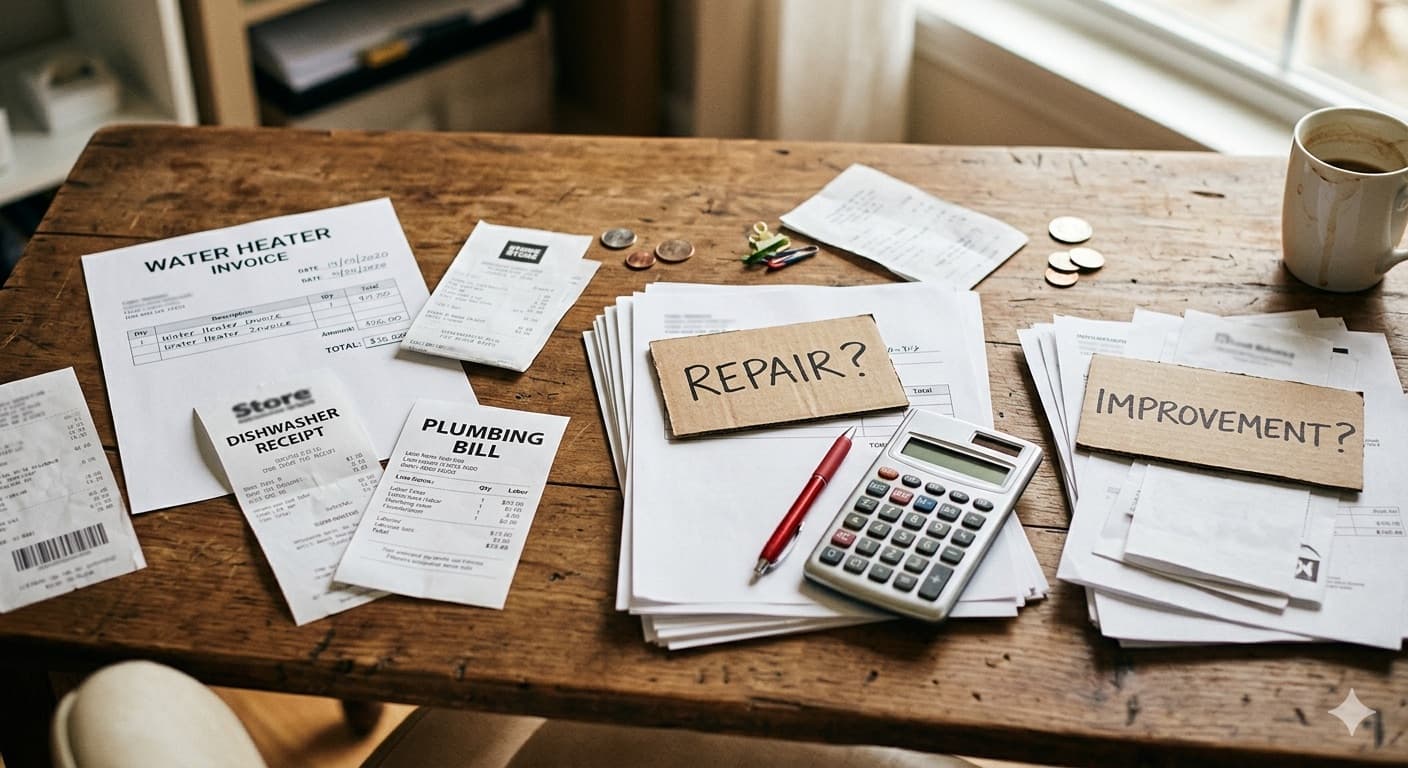
Of all the questions that paralyze small landlords at tax time, the most common is also among the most pointless. A receipt arrives in late August, sometimes for a dishwasher, sometimes for a faucet, sometimes for a length of vinyl plank flooring patched into a hallway. The landlord, alone with the receipt and the half-recalled memory of a forum post read in February, asks the question that has echoed through every shoebox since the tangible property regulations took effect in 2014: is this a repair or an improvement?
For most receipts under $2,500, the I.R.S.'s answer is: it doesn't matter.
I built Rentlab for the side-door investor with two to five units and a W-2 job, and the longer I spend with people in this category, the more convinced I am that the single largest hidden cost of small-landlord taxes is not bookkeeping software, accountant fees, or even mileage that goes unlogged. It is the time spent agonizing over a question the I.R.S. already wrote an out for. There is a rule for this. Almost no one elects it.
What follows is what the rule actually says, and what it means for the landlord whose worst tax-time ritual is reopening a folder named "maintenance?" and trying to remember the difference.
Key Takeaways
- •For most receipts under $2,500 per item, you can deduct the full cost in the year. The IRS rule is the de minimis safe harbor, and small landlords can use it as long as they expense small purchases in their own books from the start of the year
- •The election is a one-page statement filed with your tax return. It is not automatic. If you don't elect it, the rule is not available to you that year
- •A second rule, the small taxpayer safe harbor, lets you deduct every repair and improvement on a building under $1 million in basis, as long as that building's total for the year stays at or under 2% of basis or $10,000, whichever is less
- •These two rules absorb the overwhelming majority of receipts a small landlord will ever generate
- •Rentlab logs receipts as they happen and tags them so the safe-harbor decisions are obvious by April. Try it free
The question with a longer answer than it deserves
Among accountants who specialize in real estate, there is a kind of patient amusement at how thoroughly the repair-versus-improvement question has colonized the small-landlord internet. Forums fill up with photographs of replaced toilets and questions about whether painting a hallway counts. The professional answers, when they appear, are technically correct and operationally useless. Yes, a wholesale replacement of the kitchen counters is an improvement. No, regrouting a single bathroom is a repair. Yes, the new dishwasher is probably an improvement. Or maybe it is a unit-of-property analysis under the betterment, restoration, or adaptation tests. The professional cites Pub 527, sighs internally, and bills.
The reason small landlords keep asking is not that they are bad at categorization. It is that the underlying tax law is genuinely complicated, and that a wrong answer carries a real cost: a deduction missed in the current year and instead spread over 27.5 years of depreciation, or, worse, an audit-flagged misclassification.
What I.R.S. regulators noticed, more than a decade ago, was that for small property owners the costs of getting this question right exceed the tax revenue at stake. They wrote two safe harbors specifically to make the question disappear at the bottom of the receipt pile. Most small landlords have never heard of either.
What the I.R.S. actually wants
Strip away the safe harbors for a moment and the basic rule is short. Repairs are deductible in the year they are paid. Improvements are capitalized and depreciated, usually over 27.5 years for residential rental property. The line between them is drawn by three tests: a *betterment* to the property (something materially better than what was there), a *restoration* (rebuilding a major component, or restoring something allowed to deteriorate), or an *adaptation* to a new use. If a cost meets any of the three, it is an improvement.
Most receipts a small landlord pays in a given year are not close to the line. A new garbage disposal is a repair. A new HVAC system is an improvement. The questions that consume tax season tend to be the ones in the middle, and these are precisely the questions the safe harbors are designed to eliminate.
A landlord's first year adds two more sorting questions: work done before the property is ready to rent, and closing costs. See rental property tax deductions for your first year.
The $2,500 line
The de minimis safe harbor, set out in Treasury Regulation Section 1.263(a)-1(f), lets a taxpayer fully deduct the cost of any tangible property item that costs $2,500 or less per invoice, or per item as shown on the invoice. The threshold is $5,000 for taxpayers with audited financial statements, but small landlords almost always live under the $2,500 ceiling.
There is one condition besides the election. From the first day of the year, you need a consistent policy of treating purchases under that amount as expenses in your own books, and you have to follow it. The policy does not have to be written down.
What "per item" means matters here. A single invoice for $4,000 that itemizes two $2,000 dishwashers is fully deductible: each item is below the threshold. A single $4,000 dishwasher, by contrast, is not. The rule is forgiving in another way as well. It does not require the cost to qualify as a repair under the betterment-restoration-adaptation tests. It simply lets you skip the analysis for anything small enough.
For a landlord with two to five units, this is the rule that quietly absorbs most of the year's receipts:
- A water heater for $1,400.
- A dishwasher for $700.
- A ceiling fan for $180.
- A kitchen faucet for $90.
- A run of vinyl plank flooring for $1,900.
Each of these, with the election in place, is deductible in full in the year of purchase. The repair-versus-improvement question, which would otherwise have to be litigated against each receipt, never gets asked.
The second safe harbor most small landlords miss
The de minimis rule covers individual items. The small taxpayer safe harbor, set out in Treasury Regulation Section 1.263(a)-3(h), covers buildings.
If your unadjusted basis in a building is $1 million or less, and your average annual gross receipts for the prior three tax years are $10 million or less (a threshold most small landlords clear by several orders of magnitude), you may elect the safe harbor each year on a building-by-building basis. The election lets you deduct all of the year's repairs, maintenance, and improvements on that building, as long as their total does not exceed the lesser of 2% of the building's unadjusted basis, or $10,000. If the total goes over, the safe harbor is not available for that building that year.
For a duplex with a $300,000 basis, the limit is $6,000. For a single-family rental with a $450,000 basis, the limit is $9,000. Combined with the de minimis safe harbor, the practical effect is that a small landlord with an ordinary year of upkeep can deduct all of it in the year, without sorting each receipt.
One catch: the total includes items you already expensed under the de minimis rule. The two rules overlap rather than stack, so a $1,400 water heater expensed under the $2,500 rule still counts toward a $300,000 duplex's $6,000 limit.
Corrected on October 7, 2026. An earlier version of this section said that items expensed under the de minimis rule do not count toward this limit, and that the election lets you deduct up to the limit. Both were wrong: those items count, and the limit decides whether the safe harbor is available at all. If the year's total for a building goes over it, the safe harbor does not apply to that building for that year.
How to make the election
Both safe harbors are elections. They are not automatic, and they must be made every year, on the timely-filed return for that year, including extensions. There is no penalty for failing to elect them, except for the deduction the failure costs you.
The de minimis election is a single statement attached to the return, titled "Section 1.263(a)-1(f) De Minimis Safe Harbor Election," containing the taxpayer's name, address, taxpayer identification number, and a sentence affirming the election. The small taxpayer safe harbor is a comparable statement titled "Section 1.263(a)-3(h) Safe Harbor Election for Small Taxpayers," which also describes each building it covers. Once made for a year, that election cannot be revoked.
If you use a tax preparer, the conversation is two sentences long: *Please elect the de minimis safe harbor and the small taxpayer safe harbor for me this year.* If you self-file, the elections are statements attached to your return, so check that your tax software lets you add them.
Where Rentlab fits in
The safe harbors are valuable only if you can find the receipts when April arrives. The reason most small landlords don't elect them is not that the rules are objectionable. It is that the rules require, at minimum, a list of items under $2,500 with their costs and dates, and a list of building-level repairs and improvements. By April, that list is usually somewhere in a thread of text messages. If you keep your books in a spreadsheet, our free rental property expense spreadsheet puts a "Repair or improvement?" column on every row, so you can sort repairs from improvements as you go.
Rentlab is built around the assumption that a receipt is captured at the moment of purchase, not the moment of the return. When you log an expense and photograph the receipt, the expense is tagged by category and tied to the property and unit. By tax time, the de minimis-eligible items group themselves; the building-level items group themselves; and the file you hand your preparer is the list the safe harbors require. And when you are weighing whether the next big project is worth it at all, our free rental property ROI calculator shows how added repair and capital costs move a property's cash-on-cash return and cap rate.
The accountant's job becomes filing. Yours becomes signing. The shoebox becomes a habit no one performs anymore.
Stop sorting receipts after the fact. Try Rentlab free →
FAQ
Ready to simplify your rental property bookkeeping?
No credit card required