CapEx is short for capital expenditure. It means money spent to replace or add a major, long-lasting part of a rental property, such as a roof, furnace or water heater.
If you own one or two rental units, you will eventually face a big replacement. These purchases can cost far more than your regular monthly expenses. Planning ahead helps you build money for them before the bill arrives.
This guide explains what CapEx means, how it differs from maintenance and emergency savings, and how to plan for it. You will also learn how to include it in your cash flow and record purchases in your books.
Key Takeaways
- •CapEx covers big replacements, such as roofs, furnaces and windows.
- •Maintenance keeps existing parts working. A cash reserve covers surprises. CapEx covers planned replacements.
- •List your property's major items, estimate their replacement costs and set money aside each month.
- •Include your monthly CapEx savings in your cash flow calculations.
- •Record every big replacement under the correct property and keep its invoice and warranty.
What is CapEx in real estate?
CapEx in real estate means money spent on a large, infrequent purchase that replaces or adds a part of a property that lasts for years.
These are purchases that go beyond everyday upkeep. They involve replacing or adding a major part of the property rather than fixing something small.
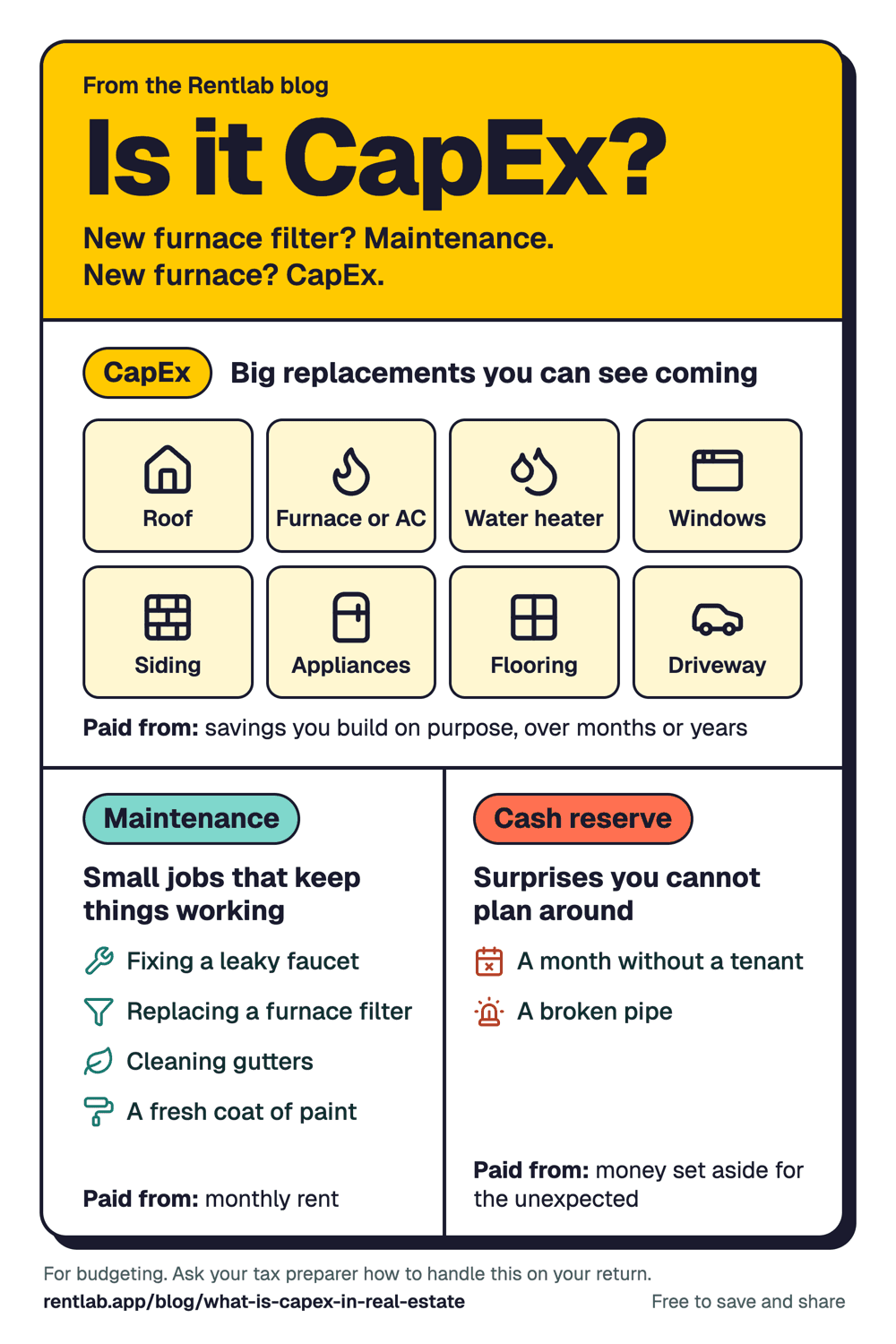
Common examples of CapEx on a rental property include:
- A roof replacement
- A new furnace or air conditioner
- A new water heater
- Replacement windows
- New siding
- Kitchen appliances
- Replacement flooring
- A new driveway or parking surface
These purchases share a few things. They tend to be expensive, happen infrequently and arrive on their own schedule.
A month's rent rarely covers a big replacement. If the furnace stops working, you need money ready before the contractor finishes the job.
That is why investors talk about CapEx. They plan ahead and set money aside over time instead of waiting for a large bill.
The word also appears in tax discussions about how a purchase appears on your return. That is a separate subject from the planning and savings covered here.
Ask your tax preparer how to handle this on your return.
CapEx vs maintenance vs a cash reserve
Maintenance, a cash reserve and CapEx are three different buckets of money. Each one covers a different type of rental property expense.
Maintenance covers small, frequent jobs that keep what you already have working. These are routine tasks that come up as you manage your property.
Examples include:
- Fixing a leaky faucet
- Replacing a furnace filter
- Cleaning gutters
- Applying a fresh coat of paint
These expenses come out of your regular monthly rental income.
A cash reserve is money you set aside for unexpected expenses. These are surprises that you cannot plan around, such as a month without a tenant or a broken pipe.
A reserve gives you money to handle an unexpected bill without borrowing. The CFPB guide to building an emergency fund explains why keeping money available for unexpected expenses matters.
CapEx is the third bucket. It covers big replacements that you can see coming because a part has an age and condition.
You save for these purchases on purpose, over months or years. You do not have to hope your emergency reserve can cover a replacement when it arrives.
The three buckets also affect each other. Regular maintenance can delay the need for a big replacement.
For example, fixing leaks quickly, keeping gutters clean and making sure the ground slopes away from your foundation can help protect your property. The EPA guide to mold, moisture and your home covers these maintenance steps.
Tip: Keep separate records for maintenance, emergency savings and CapEx. This makes it easier to see where your rental money goes.
How to plan for CapEx on a rental property
You can plan for CapEx by listing the major items in your property, estimating their replacement costs and setting aside money each month.
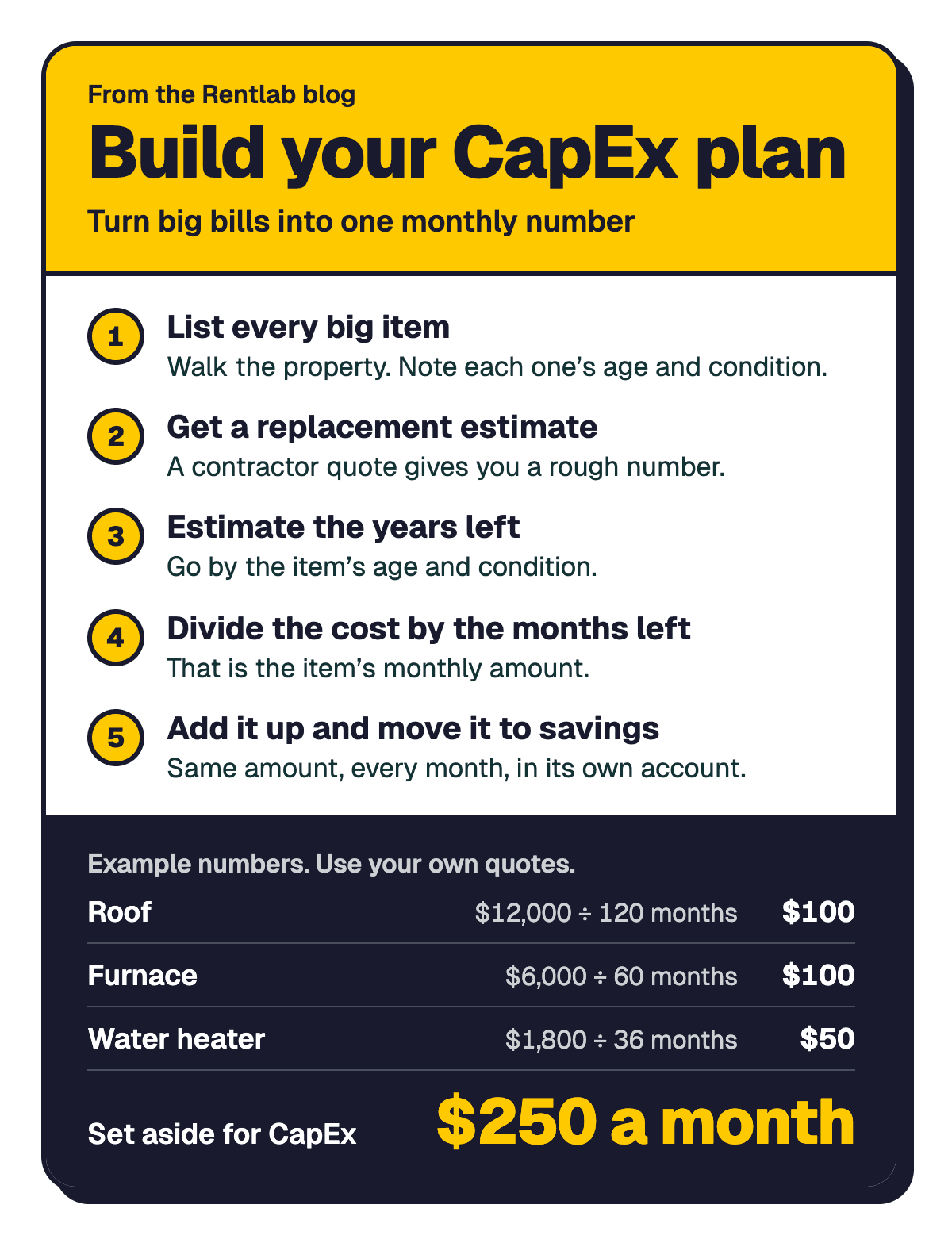
Start with a walk through your rental. Look at the major parts that may need replacement in the future. Write down their age and current condition.
Next, research what each replacement might cost. A contractor quote can help you get a rough estimate. You can also research costs for comparable work in your area.
For each item, estimate how many years it has left before replacement. Then divide its estimated replacement cost by the months remaining. Add the monthly amounts together.
Here is how that works. These are example numbers only, so use your own quotes:
- Roof: $12,000 with 10 years left (120 months) is $100 a month.
- Furnace: $6,000 with 5 years left (60 months) is $100 a month.
- Water heater: $1,800 with 3 years left (36 months) is $50 a month.
Together, that is $250 a month to set aside for CapEx.
Use this checklist to build your CapEx plan:
- Walk the property and list every big item.
- Write down the age and condition of each.
- Get a replacement estimate for each.
- Estimate the years left.
- Divide each cost by the months left.
- Add the monthly amounts.
- Move that amount to a separate savings account every month.
Keep your CapEx money in its own savings account. Separate it from the checking account that pays your regular monthly bills.
This makes it easier to see what money is available for replacements. It also reduces the chance of spending those savings on routine expenses.
The IRS recommends keeping business money in its own bank account. See IRS Publication 583 for its explanation of business accounts and records.
Review your list once a year. An item may change after a storm, inspection or repair. Update its condition, estimated replacement cost and remaining years.
There is no percentage-of-rent shortcut or average lifespan that works for every property. Your own property's age, condition and replacement estimates are what matter.
Watch out: Do not pull from your CapEx account to cover a slow month. That is what your cash reserve is for. Spending the replacement money early could leave your roof unfunded when it fails.
How CapEx changes your cash flow
Cash flow is the rent left after every bill is paid. Your CapEx savings should be part of that monthly calculation.
A rental property can appear to earn money every month. Then the furnace fails, and one large bill takes away that money in an afternoon.
Without a CapEx plan, you may not see the full cost of owning and maintaining the property. The monthly set-aside helps turn one large future bill into a steady budget item.
Treat your CapEx set-aside as a monthly cost when working out what your rental property really leaves you. The money stays in your own savings account, but it is still set aside for a future property expense.
You can use the rental property ROI calculator to see how monthly costs change a property's return.
ROI stands for return on investment. It measures the return a property produces compared with the money invested in it.
Enter your property's figures in the calculator and review the result. The result helps you see how your costs affect the return. Include your planned CapEx savings when working out what the property leaves you each month.
How to record a CapEx purchase in your books
Record a CapEx purchase on the day you pay it. Enter it under the correct property, with the date, amount and what was replaced. Keep the contractor's invoice and any warranty paperwork.
A clear record gives you a place to find the details when you need them later.
Use this checklist whenever a big replacement arrives:
- Record the date and the full amount.
- Note which property and which part was replaced.
- Photograph the invoice and the receipt.
- File the warranty with the receipt.
- Mark it apart from routine maintenance in your records.
Keeping CapEx on its own line in the free rental property expense spreadsheet makes the year's total easy to read. It also keeps big replacements from hiding among small repairs.
The tax side is separate from your bookkeeping records. The IRS explains this in IRS Publication 527. The article How small landlords can stop second-guessing whether a receipt is a repair or an improvement explains how the IRS draws that line.
The IRS explains this in IRS Publication 527.
Rentlab keeps each of these purchases under the right property.See howStart by walking through your rental property and listing its major items. Write down their age and condition, then get replacement estimates. This gives you a starting point for a monthly CapEx savings plan.
Keeping these expenses organized also helps you understand where your rental income goes. Rentlab records rent and expenses by property. Its on-screen reports include Schedule E, Profit & Loss and Cash Flow Statement.
Rentlab does this for you
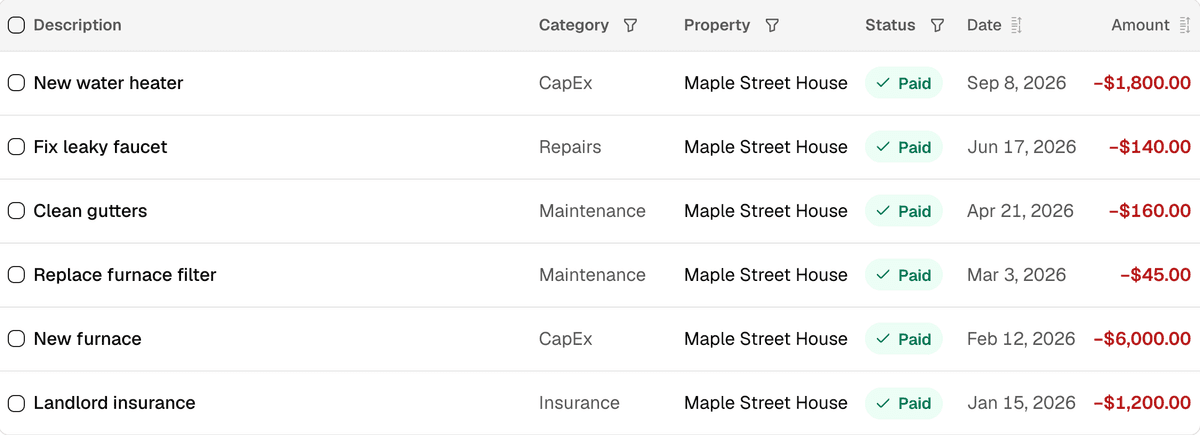
Every big replacement, kept by property
Record each big replacement under its property. Rentlab keeps your rent and expenses together and shows the result in your Cash Flow Statement.
FAQ
Sources
Stop tracking big replacements by hand
Your rent and expenses stay recorded by property, so you can see what each rental really costs you.
No credit card required